"Always be ready to speak your mind, and a base man will avoid you." – William Blake (1757-1827) from The Marriage of Heaven and Hell

Sunday, 14 March 2021

Karl Marx: the Man and the Myths

On this day in 1883, "at a quarter to three in the afternoon, the greatest living thinker ceased to think. He had been left alone for scarcely two minutes and when we came back, we found him in his armchair, peacefully gone to sleep – but forever."

The words of Friedrich Engels, in the funeral oration that he delivered at the graveside of his friend and collaborator, Karl Heinrich Marx, on 17 March 1883. He concluded with the plain yet lofty assertion that "his name will endure through the ages and so also will his work", a prediction that has been vindicated with the passage of time.


For those who knew Marx, no legend is funnier than that which portrays him as a morose, embittered, unbending and unapproachable person, a sort of Jupiter Tonans, ceaselessly hurling his thunderbolts with never a smile on his lips, enthroned alone and aloof in Olympus. Such a description of the merriest, gayest person who ever lived, the man bubbling over with fun, whose laughter irresistibly won one's heart, the most friendly, gentle and sympathetic of all companions, is a constant source of amazement and amusement to all who knew him. – Eleanor Marx (1855-1898), youngest daughter of Karl Marx and Jenny von Westphalen


For Marx was before all else a revolutionist. His real mission in life was to contribute, in one way or another, to the overthrow of capitalist society and of the state institutions which it had brought into being, to contribute to the liberation of the modern proletariat, which he was the first to make conscious of its own position and its needs, conscious of the conditions of its emancipation. Fighting was his element. And he fought with a passion, a tenacity and a success such as few could rival. – Friedrich Engels (from his Speech at the Grave of Karl Marx, Highgate Cemetery, London, 17 March 1883)


Saturday, 28 November 2020

Friedrich Engels (1820-1895): Born 200 Years Ago Today!

Friedrich Engels
Friedrich Engels (1820-1895)
Public domain via Wikimedia Commons

Friedrich Engels, German-born author, journalist, philosopher, historian, political activist was born 200 years ago today, in 1820.

As chief collaborator with Karl Marx, together they made and important and ground-breaking discoveries in both general and particular fields of social science, primarily by pioneering and advancing a materialist conception of history, based on a dialectical understanding of human society, in much the same vein as what Darwinism was accomplishing, around the same time, in the field of natural science.

Engels both completed and continued Marx's work following his death in 1883, before his own death, twelve years later in 1895. He also made individual contributions, contained in such works as The Condition of the Working Class in England (published in 1845), Dialectics of Nature (1883), The Origin of the Family, Private Property and the State (1884).

As one notable revolutionary and commentator or a later period observed, a key to understanding the motives and disposition of Marx and Engels is that "they both became socialists after being democrats, and the democratic feeling of hatred for political despotism was exceedingly strong in them. This direct political feeling, combined with a profound theoretical understanding of the connection between political despotism and economic oppression, and also their rich experience of life, made Marx and Engels uncommonly responsive politically." – V.I. Lenin, Frederick Engels

They were "the first to show that the working class and its demands are a necessary outcome of the present economic system … the first to explain that socialism is not the invention of dreamers, but the final aim and necessary result of the development of the productive forces in modern society … the first to say that the proletariat is not only a suffering class; that it is, in fact, the disgraceful economic condition of the proletariat that drives it irresistibly forward and compels it to fight for its ultimate emancipation." – Ibid

Friedrich Engels was born on 28 November 1820, in Barmen in the Rhine Province of what then constituted Prussia. His life and work took him to many countries of Europe, meeting with revolutionaries and important intellectual figures of the 19th century but also and most importantly, with the downtrodden and oppressed, with whom he was never out of contact.

Thursday, 31 October 2019

Contributions to the Critique of Political Economy: Joan Robinson (1903-1983)

Joan Robinson (née Maurice), who was born on this day in 1903, in Surrey, England, was a Cambridge-educated economist. Her work in this field has led her to be regarded as a key figure of so-called 'Post-Keynesian school' of thought. However, she is also noted for having devoted considerable time to the study of Karl Marx and his contribution to the development of economic theory – e.g. An Essay on Marxian Economics (1942). Such works are even said to have helped to revive debate on this aspect of Marx's legacy.

She visited many countries – including the Soviet Union, China, Korea, India – during her lifetime. She expressed particular interest in the experiences of 'the developing world' and those countries emerging from the shackles of colonialism in the period that followed the end of World War II.

These excerpts from her work and public statements of her views, have been chosen mainly for presentational purposes and their quotability. They are not put forward as representing any kind of summation or broad assessment but, do help to focus on some of key challenges that practitioners of the study of modern-day political economy needs to address.

The purpose of studying economics is not to acquire a set of ready-made answers to economic questions, but to learn how to avoid being deceived by economists. - Joan Robinson

The only thing worse than being exploited by capitalism is not being exploited by capitalism. - Joan Robinson

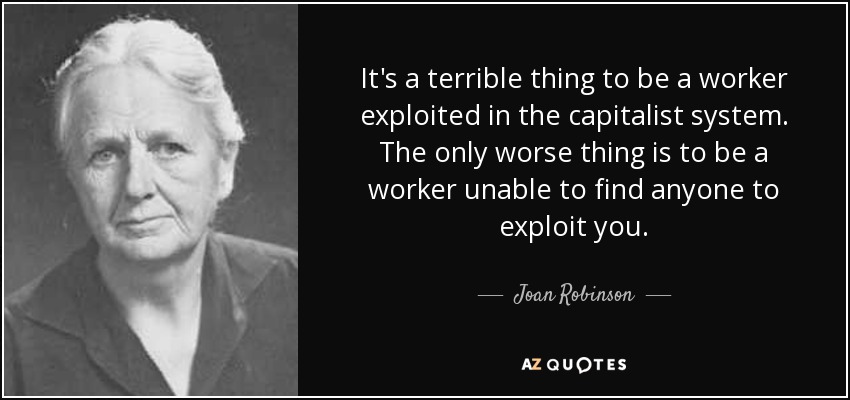
It's a terrible thing to be a worker exploited in the capitalist system. The only worse thing is to be a worker unable to find anyone to exploit you. - Joan Robinson

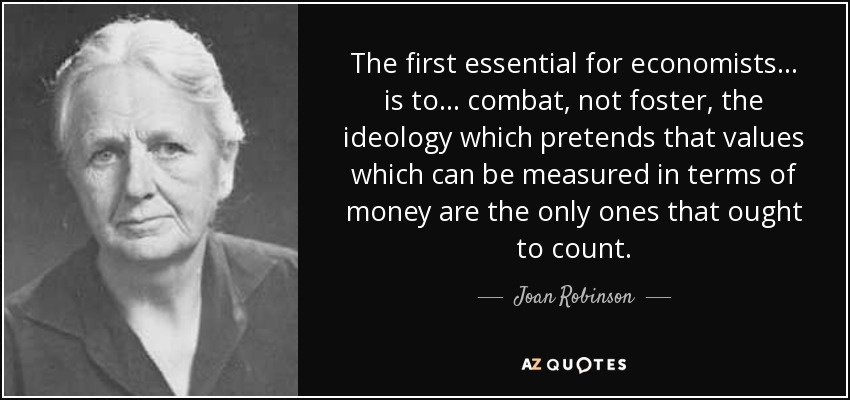
The first essential for economists ... is to ... combat, not foster, the ideology which pretends that values which can be measured in terms of money are the only ones that ought to count. - Joan Robinson

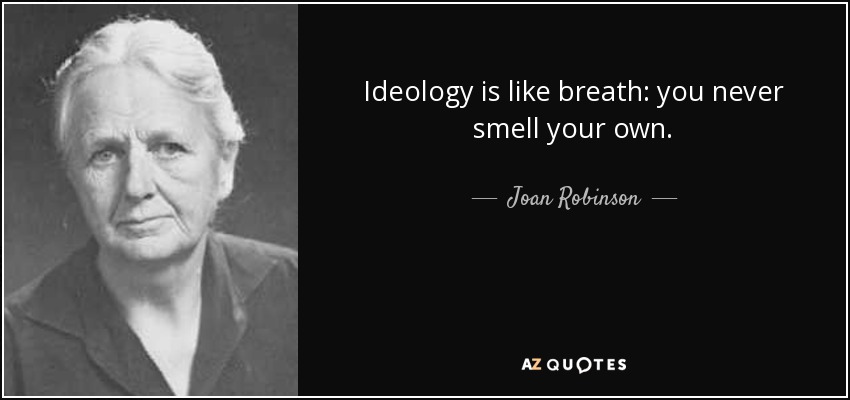
Ideology is like breath: you never smell your own. - Joan Robinson

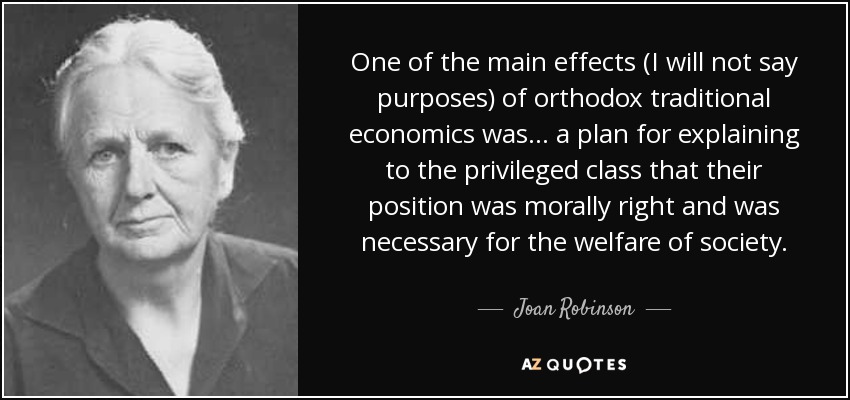
One of the main effects (I will not say purposes) of orthodox traditional economics was ... a plan for explaining to the privileged class that their position was morally right and was necessary for the welfare of society. - Joan Robinson

The very nature of economics is rooted in nationalism. ... It [was] developed ... in the hope of throwing light upon questions of policy. But policy means nothing unless there is an authority to carry it out, and authorities are national. - Joan Robinson

Marxism is the opium of the Marxists. - Joan Robinson

The fundamental differences between Marxian and traditional orthodox economics are, first, that the orthodox economists accept the capitalist system as part of the eternal order of Nature, while Marx regards it as a passing phase in the transition from the feudal economy of the past to the socialist economy of the future. - Joan Robinson

Unemployment is a reproach to a democratic government. - Joan Robinson

Even if the crises that are looming up are overcome and a new run of prosperity lies ahead, deeper problems will still remain. Modern capitalism has no purpose except to keep the show going. - Joan Robinson

I do not regard the Keynesian revolution as a great intellectual triumph. On the contrary, it was a tragedy because it came so late. Hitler had already found out how to cure unemployment before Keynes had finished explaining why it occured. - Joan Robinson

It is the business of economists, not to tell us what to do, but show why what we are doing anyway is in accord with proper principles. - Joan Robinson

Whatever you can rightly say about India, the opposite is also true. - Joan Robinson

If a rise in wages does not raise prices, a fall will not reduce them. - Joan Robinson

Unequal distribution of income is an excessively uneconomic method of getting the necessary saving done. - Joan Robinson

But, as soon as speculators become an important influence in the market, their business is to speculate on each others behaviour. - Joan Robinson

science progresses by trial and error, and when it is forbidden to admit error there can be no progress. - Joan Robinson

Rosa Luxemburg maintained that the capitalist system can keep up its rate of investment (and therefore its profits) only so long as it is expanding geographically. - Joan Robinson

A depression is a situation of self-fulfilling pessimism. - Joan Robinson

we make a great fuss about national conscience, but it consists mainly in insisting upon everyone ascribing our national policy to highly moral motives, rather than in examining what our motives really are. - Joan Robinson

Reality is never a golden age. - Joan Robinson

It seems that neither the Keynesian nor the Marxian prognosis of the future of capitalism is being fulfilled and we are left without any particular theory as to what will happen next. - Joan Robinson

I came away from the talk with the perception that the risk of adverse side effects is so much greater than the risk of cervical cancer, I couldn’t help but question why we need the vaccine at all. - Joan Robinson

Marx, however imperfectly he worked out the details, set himself the task of discovering the law of motion of capitalism, and if there is any hope of progress in economics at all, it must be in using academic methods to solve the problems posed by Marx. - Joan Robinson

owning capital is not a productive activity. - Joan Robinson

The orthodox doctrines of economics which were dominant in the last quarter of the nineteenth century had a clear message. They supported laisser faire, free trade, the gold standard, and the universally advantageous effects of the pursuit of profit by competitive private enterprise. - Joan Robinson

Not only subjective poverty is never overcome by growth, but absolute poverty is increased by it. ... Absolute misery grows while wealth increases. - Joan Robinson

If there is any law governing the distribution of income between classes, it still remains to be discovered. - Joan Robinson

It is the rate of investment which governs the rate of saving, and not vice versa. - Joan Robinson

New ideas are difficult just because they are new. Repetition has somehow plastered over the gaps and inconsistencies in the old ones, and the new cannot penetrate. - Joan Robinson

It is much easier to organize control over one industry serving many markets than over one market served by the products of several industries. - Joan Robinson

It is impossible to add the stock of money to the flow of saving. - Joan Robinson

Income from property is not the reward of waiting, it is the reward of employing a good stockbroker. - Joan Robinson

An economy may be in equilibrium from a short-period point of view and yet contain within itself incompatibilities that are soon going to knock it out of equilibrium. - Joan Robinson

In all the talk in the Principles (as opposed to the formal analysis) it is not the saving of rentiers but the energy of entrepreneurs which governs accumulation. - Joan Robinson

At any moment there is certainly not balanced trade between the various areas of the habitable globe that happens to be under seperate national governments - there is an ever-changing pattern of deficits and surpluses. - Joan Robinson
"Capitalism with near-full employment was an impressive spectacle. But a growth in wealth is not at all the same thing as reducing poverty. A universal paean was raised in praise of growth. Growth was going to solve all problems. No need to bother about poverty. Growth will lift up the bottom and poverty will disappear without any need to pay attention to it. The economists, who should have known better, fell in with the same cry." ~ Joan Robinson
"It is a popular error that bureaucracy is less flexible than private enterprise. It may be so in detail, but when large scale adaptations have to be made, central control is far more flexible. It may take two months to get an answer to a letter from a government department, but it takes twenty years for an industry under private enterprise to readjust itself to a fall in demand." ~ Joan Robinson

Sources:


Saturday, 5 May 2018

On the Occasion of the 200th Anniversary of the birth of Karl Marx (1818-1883)

Karl Marx 001
[Public domain], via Wikimedia Commons
Karl Heinrich Marx was born 200 years ago today. He was born in the German town of Trier, in what was then the Kingdom of Prussia, in 1818.

Karl Marx was the most important intellectual figure of the 19th century, whose contributions to various fields of social science – including political theory, philosophy, economics – laid the basis for the immense social transformations, on a world scale, that would follow in the 20th century.

His work was and remains revolutionary and Marx himself was a committed revolutionary, not in the mere academic sense, as one who hid behind books and borrowed phrases. Rather, Marx actively participated in building the revolutionary movement of the day, that rose to challenge the existing social order at the very moment of its inception.

He was, first and foremost, a scientific socialist. Along with his followers, they took a stand against both utopian and anarchistic trends that were vying for influence, guiding the nascent working class movement on a path that would give rise to the most consistently revolutionary struggle.

His theories and ideas are often summarised or encapsulated by the term, dialectical and historical materialism. He was the first to identify the law of motion of society in general and capitalist society in particular. The importance of this contribution cannot be overstated because, although much has changed since Marx's day, the character of the epoch which he identified has not been altered fundamentally.

It was Marx who set forth the idea that each period of human history is characterised by the ascendancy of a new class but, the emergence of such social classes is itself the outcome of the relations that people enter into in the process of procuring a livelihood. The onset of capitalism had socialised the process of production to a height not seen before. At the same time, the private character of appropriation of the surplus arising out of this socialised production, was a contradiction which the pioneers of capitalism would not and could not resolve in the interests of society as a whole. Such a task fell to the working class – itself the product of the capitalist mode of production but also, its gravediggers – it being in their basic self-interest to secure such an outcome.

On the 200th anniversary of the birth of Karl Marx, it can readily be seen how important and influential a figure he was and is. The thoughts and ideas expressed in his writings represent the high road of human civilisation, the full potential of which is only just being realised.


Tuesday, 7 November 2017

The Enduring Legacy of the Great October Socialist Revolution, 100 Years On

Commemorations being held across the world to mark the 100th anniversary of the Great October Socialist Revolution bear testimony to the important regard that these events are held, not just in the hearts and minds of millions but, indeed, in the history of humankind, representing what, for the time, was a vital stepping stone in stages by which human beings seek to transform their way of life and mode of living. Such celebrations confirm that the transformations given rise to by events of over 100 years ago are now firmly stitched into the very fabric of our social being, at all levels and can only be undone by the tearing of that society asunder – a useless folly that, nevertheless, some still entertain, for reasons of fanatical delusion or cold, calculating, self-serving interest.

The fact that these events are not being officially commemorated in the country (Russia) that gave rise to them, nor even, the fact that the country (the Union or Soviet Socialist Republics or USSR) that came into being as a result no longer exists, has no bearing on the significance of this legacy to today's context. The Great October Socialist Revolution brought forward the most profound, ongoing social transformations that the world has yet experienced. Its tremors are still being felt; its lessons remain invaluable.

From the beginning, the transformations that the Great October Socialist Revolution gave rise to were recognised for the worldwide significance and vitally important opportunity that they represented. Their origins lie, not merely in the events that took place on this day in 1917, in Petrograd (St. Petersburg) and other cities of the Russia Empire. Nevertheless, these events represent a certain watershed moment, sending out a call around the world that was answered by millions around the world. They constituted the opening salvo, ushering in of the new era (the era that is still upon us) – that of imperialism and proletarian revolution.

Assemblée du soviet de Petrograd en 1917
By User Kristallstadt on en.wikipedia [Public domain], via Wikimedia Commons
Of course, like all great revolutions (and even some not so great), the October Socialist Revolution also gave rise to counter-currents, enlisting to their side those most entrenched and reactionary forces, opposed (quite violently, in many cases) to the revolutionary current, seeking to halt and even turn back the very necessary process of social transformation now unleashed.

Eastern Phoebe nest / Brown-headed Cowbird egg
By Galawebdesign
(Own work by uploader
http://galawebdesign.com)
[CC BY 3.0],
via Wikimedia Commons
At this juncture in history, on the occasion of the 100th anniversary of the Great October Socialist Revolution, we can say definitively that it represents the singular event of the 20th century: the event that heeded the demands of the time, allowing for their realisation. Even if the fullest transformation has yet to be achieved, those transformations that have been achieved may now be regarded as complete and irrevocable from an historical perspective. This is evidenced, not least, in the manner that those forces and counter-currents who were and are opposed to these trends, now seek to take credit for the advances and gains that have been made, even so daring as to wallow and luxuriate in them. In this sense, imperialism can be observed in the same light as a brood parasite – the cuckoo that lays its eggs in the nests of the unsuspecting; its offspring waiting for the moment to reveal its true nature, before devouring every thing and one around.

Reed warbler cuckoo
By Per Harald Olsen (Own work)
[GFDL or CC-BY-SA-3.0],
via Wikimedia Commons
The process of social transformation that took its first steps 100 years ago today is far from extinguished. As has been pointed out before, it can only be extinguished through the common ruin of all contending classes and the destruction of all human society. It stands to reason therefore, that now it must continue on its path, towards the full realisation and completion of its goals, in all spheres, culminating in the dawning of an entirely new era, hitherto unknown (unfathomable perhaps, by reference to today's standards) in human history.


Sunday, 9 April 2017

Whither Britain? The Brexit Debate. What's it all about, Alfie?

'Brexit means Brexit', as we are now so used to hearing but what does Brexit actually mean?


The full interview with Roberto Saviano (European Leaders Won't Admit to Mafia) is available from Euronews Channel.

Wednesday, 8 March 2017

The Revolutionary Legacy – No Coincidence!

March 8th is the date traditionally celebrated, throughout the world, as International Women's Day. In 2017, it coincides with the 100th anniversary of the February Revolution in Russia: an event that overthrew feudal autocracy in that country but also proved the harbinger of much greater revolutions, that were not just international but worldwide in scope. This coincidence is not entirely coincidental however!

Nőnap - Petrográd, 1917.03.08
Public domain], via Wikimedia Commons

The origins of International Women's Day, as a day of celebration, can be freely researched, though it raises many interesting questions in the process, such that the wider significance might be easily overlooked:
The earliest Women's Day observance was held on February 28, 1909, in New York and organized by the Socialist Party of America. A Women's Day demonstration on March 8, 1917 in Petrograd sparked the Russian Revolution. Declared a national holiday in the Soviet Russia in 1917, it was predominantly celebrated by the socialist movement and communist countries until it was adopted in 1977 by the United Nations. – Wikipedia

Most accounts of the February Revolution of 1917 describe the key events as those that took place between 8th to 16th March 1917 (23 February to March 3 according to the Julian calendar still in use in Russia at the time, which was 13 days behind the Gregorian calendar, first proposed in 1582, that had been adopted elsewhere and most commonly used today):
On February 18, 1917, a strike broke out at the Putilov Works in Petrograd. On February 22 the workers of most of the big factories were on strike. On International Women's Day, February 23 (March 8), at the call of the Petrograd Bolshevik Committee, working women came out in the streets to demonstrate against starvation, war and tsardom. The Petrograd workers supported the demonstration of the working women by a city-wide strike movement. The political strike began to grow into a general political demonstration against the tsarist system. - from History of the Communist Party of the Soviet Union 'Bolsheviks' (short course), 1938

The History... goes further however, recounting events both preceding and following on from the Russian Revolution of February 1917, even if it is only a 'short course'.

This is a theme that we will be returning too in the course of this 'year of centenaries' that lies ahead – and not just as a historical retrospective.

Демонстрация работниц Путиловского завода в первый день Февральской революции 1917
[Public domain], via Wikimedia Commons


Sunday, 8 December 2013

Remembering Nelson Mandela

Great tributes, befitting the man, have been paid to the late Nelson Rolihlahla Mandela, who died this week at the age of 95. A towering figure in the struggle for democracy and to overthrow the vestiges of colonialism in his own country - of which he was the first democratically-elected president - as well as an international statesman of considerable stature and renown.

Not unexpectedly, in the midsts of all the sincere and heartfelt tributes, hypocritical exaltations have attempted to make themselves heard. This can be observed in the manner in which Mandela is being referred to in some quarters, with the 'honorific' title of 'first black president of South Africa'. Are such people really so oblivious to Mandela's key achievements? In which case, let us then re-iterate what they consisted of: the role he played in dismantling the remnants of racial segregation, practised in many colonised parts of Africa and institutionalised in South Africa in 1948, under the name of 'apartheid'?

As the first democratically-elected president of all South Africans, Mandela was instrumental in ushering in the non-racial era, for a society governed by majority rule, based on universal adult suffrage. To refer to his legacy in any other terms is to attempt to dilute it. Clearly there are those who still wish that the legacy of a revolutionary life might die with the man.

Of course Mandela's revolutionary legacy was not limited to matters pertaining to his own country, but also to the principled stand he took on the international stage, in support of other peoples fighting against the weight of tyranny, injustice and oppression.


Mandela - In His Own Words

No country can claim to be the policeman of the world and no state can dictate to another what it should do. Those that yesterday were friends of our enemies have the gall today to tell me not to visit my brother Gaddafi. They are advising us to be ungrateful and forget our friends of the past. - from a Speech in Tripoli, May 18, 1990

If there is a country that has committed unspeakable atrocities in the world, it is the United States of America. They don’t care for human beings. - address to International Women’s Forum in Johannesburg, 2003, prior to US-led invasion of Iraq.

If you look at those matters, you will come to the conclusion that the attitude of the United States of America is a threat to world peace. - Newsweek interview, 2002

Israel should withdraw from all the areas which it won from the Arabs in 1967, and in particular Israel should withdraw completely from the Golan Heights, from south Lebanon and from the West Bank. - comments reported during a visit to Israel, 1999

The UN took a strong stand against apartheid; and over the years, an international consensus was built, which helped to bring an end to this iniquitous system. But we know too well that our freedom is incomplete without the freedom of the Palestinians. - Address at The International Day of Solidarity with the Palestinian People (4 December 1997)

Sources used in this post:


Tuesday, 26 June 2012

Anatomies of the World Economies part ii - The Great Malls of the PR of China


Friday, 15 June 2012

How Political Power is Exercised in the Anglo-American World

from IPCO - Queen of the World -:

As British Monarch, Queen Elizabeth ll is officially the wealthiest, most powerful person on earth. She embodies the 'Crown' and supreme world power.
The Presidents of the United States of America are forbidden any nobility and are subservient to the Monarch. The US President is Commander and Chief of the US Armed Forces based at Camp David, which is known to insiders as Camp King David.
Prime Ministers in Commonwealth Nations like Canada, Australia and New Zealand are also subservient to the Queen. The Governor Generals of the Queen's Commonwealth Nations, represent and exercise the Queens power on her behalf. What the general public doesn't realize is that their leaders are only representatives of the monarch and do not posses the power, they only exercise the power. They do not REIGN they RULE. The Monarch on the other hand REIGNS but does not RULE
By delegating her powers but not exercising her powers, the Queen is left safely outside and above the conflicts and divisions of the political process, protected from becoming a target of political hostilities. - [you can read rest of this article on the website of the International People's Conference Organisation.]

'via Blog this'

Wednesday, 13 June 2012

Capitalism - the origins and meaning of a phrase

"Capitalism," a term of disparagement coined by socialists in the mid-nineteenth century, is a misnomer for "economic individualism", which Adam Smith earlier called "the obvious and simple system of natural liberty" (Wealth of Nations). Economic individualism's basic premise is that the pursuit of self-interest and the right to own private property are morally defensible and legally legitimate. Its major corollary is that the state exists to protect individual rights. Subject to certain restrictions, individuals (alone or with others) are free to decide where to invest, what to produce or sell, and what prices to charge. There is no natural limit to the range of their efforts in terms of assets, sales, and profits; or the number of customers, employees, and investors; or whether they operate in local, regional, national, or international markets. - from Capitalism: The Concise Encyclopedia of Economics | Library of Economics and Liberty:

'via Blog this'

Tuesday, 12 June 2012

Anatomies of the World Economies part i - United States of America

Robert B. Reich is currently Professor of Public Policy at the University of California at Berkeley, USA and was Secretary of Labor in the Clinton administration. His website is at RobertReich.org.


Sunday, 10 June 2012

The Pyramid of Capitalism, 1911 | Industrial Workers of the World


Popular Posts